7 Best Ways to Choose a Reliable Beauty Equipment Maker?

Time:2026-10-15 Author:Sophia
0%

Choosing the right supplier can shape your clinic’s safety, reputation, and long-term profitability. That is why many buyers search for how to choose a reliable beauty equipment manufacturer before signing a contract. A polished website is not enough. The real evidence appears in certification records, factory audits, warranty terms, and post-sale support.

Dr. Michael H. Gold, a board-certified dermatologist and aesthetic medicine educator, offers a practical principle: “The safest device is the one you understand, maintain, and use correctly.” This idea should guide every supplier conversation. Ask who designed the device, where it is assembled, and how performance is tested. Request traceable documents, including quality-management certificates, clinical evidence, user manuals, and service procedures. Reliable manufacturers explain limitations clearly. They do not promise instant results.

Look closely at the details. Can the company provide operator training? Are replacement handpieces available? Does technical support answer within one business day? Speak with existing customers, not only selected testimonials. Visit the production site when possible. Check packaging, calibration labels, and serial-number records. Small details matter.

No supplier is perfect.

I have seen buyers focus too heavily on price. That decision often creates hidden costs through downtime, repairs, or weak training. A cheaper machine may become expensive within months. Still, even an established manufacturer deserves careful verification. Reputation can change. Use independent evidence, written agreements, and realistic performance expectations. This guide presents seven practical ways to assess a beauty equipment maker with greater confidence, care, and professional judgment.
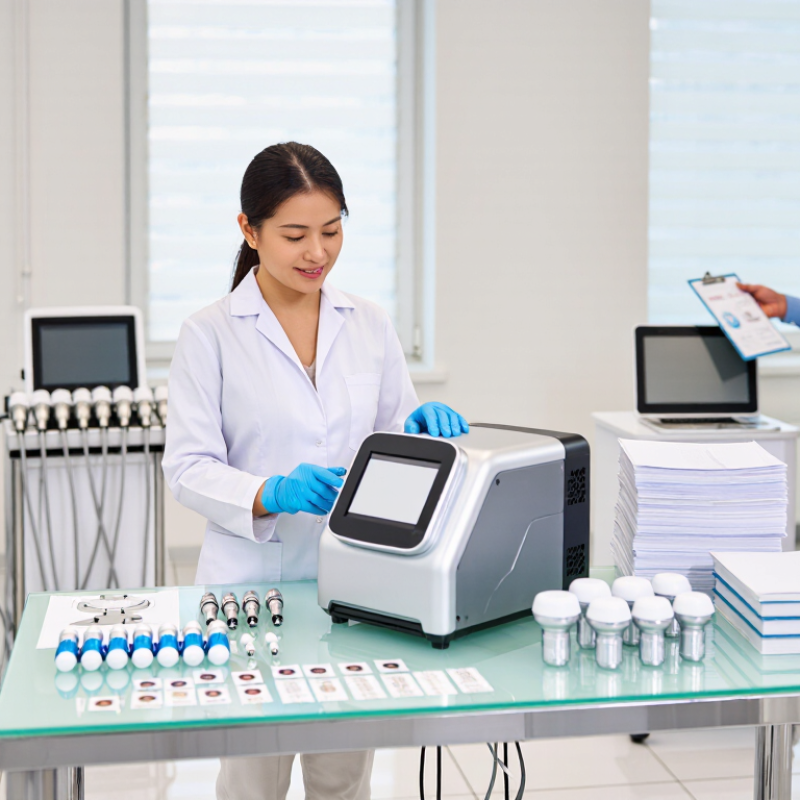
7 Best Ways to Choose a Reliable Beauty Equipment Maker?

Define Your Beauty Equipment Requirements and Quality Standards

Before choosing a beauty equipment maker, define the exact treatment, user group, and operating environment. A facial steamer for a small studio needs different controls than a high-frequency device for a clinic. Write measurable requirements, including energy output, treatment time, temperature range, noise level, cleaning method, and expected daily workload. Do not rely on attractive product photos. They reveal almost nothing about internal safety design.

Quality standards should match the equipment’s risk. Ask for documented testing, traceable components, electrical safety reports, and a clear quality management process. ISO Survey 2023 recorded more than 1.2 million ISO 9001 certificates worldwide, showing how widely quality systems are used. Yet certification alone does not prove consistent manufacturing. Request recent inspection records, calibration procedures, sample test results, and failure-rate data. The 2024 Global Wellness Economy Monitor valued the wellness economy at $6.3 trillion in 2023. Fast growth can encourage rushed production, which deserves careful questioning.

Tips: Build a one-page specification sheet before contacting makers. Test a production sample under realistic conditions, including repeated heating and cleaning cycles. Check whether the manual explains faults clearly. Ask who supplies replacement parts and how quickly support responds. I would also record small defects, such as loose buttons or uneven casing gaps. They may seem minor, but they can signal weak process control. My earlier mistake was trusting polished demonstrations too quickly. A quieter, slower evaluation often exposes more useful evidence.

Verify the Maker’s Certifications, Compliance, and Manufacturing Expertise

A reliable beauty equipment maker should prove compliance, not merely display certificates. Ask for the certificate number, issuing body, validity dates, and covered factory address. The scope must include the exact equipment category. ISO 9001 supports quality management, while ISO 13485 is more relevant when equipment has a medical purpose. The ISO Survey 2022 reported more than 1.2 million valid ISO 9001 certificates worldwide, but quantity does not guarantee strong production control.

Request recent audit records, risk assessments, electrical safety tests, and calibration reports. For applicable devices, evidence aligned with IEC 60601 can show control of electrical and clinical safety risks. Check whether the maker maintains material traceability from incoming components to finished units. A serious factory also documents corrective actions, complaint handling, software changes, and supplier evaluations. The World Health Organization has repeatedly identified weak regulatory oversight as a major medical-device safety concern. That warning deserves attention in aesthetic equipment procurement.

Tips: Contact the certification body directly. Do not trust a PDF alone. Visit the production floor, if possible. Look for labeled inspection stations, controlled storage, clean assembly areas, and trained operators. Ask to review one anonymized batch record. A polished showroom can hide weak processes. No audit is flawless. I would also compare certificates against the factory’s real capabilities, because a maker may outsource critical work without clearly explaining it. Credible manufacturers answer technical questions precisely, admit limitations, and provide measurable evidence instead of vague promises.

7 Best Ways to Choose a Reliable Beauty Equipment Maker? – Verify the Maker’s Certifications, Compliance, and Manufacturing Expertise

No. Evaluation Dimension What to Check How to Verify It Reliable-Maker Indicator
1 Quality Management Certification A current ISO 9001 certificate demonstrates that the organization operates a quality management system. For equipment classified as a medical device, ISO 13485 may be relevant because it is specifically designed for medical-device quality management systems. Check the certificate scope, manufacturing site, validity dates, certification body, and accreditation status. Confirm that the certificate covers the actual product category and facility involved in production. Strong evidence
The certificate is current, site-specific, and issued for a scope relevant to the equipment being purchased.
2 Regulatory Classification and Compliance Determine whether the product is a cosmetic device, general electrical equipment, or a medical device according to its intended use, claims, and market. Medical-device requirements can be more extensive than requirements for non-medical beauty equipment. Request the product classification rationale, declaration of conformity where applicable, technical documentation summary, labeling, instructions for use, and evidence supporting the maker’s stated claims. Essential
The maker clearly explains applicable regulations instead of using a generic “certified” statement.
3 Electrical and Product Safety Testing Relevant safety evaluation may include electrical safety, electromagnetic compatibility, laser or intense-pulsed-light safety, photobiological safety, and mechanical or thermal hazards, depending on the equipment design. Review test reports from competent laboratories. Match the report model number, product configuration, rated voltage, accessories, and test standards to the exact unit being offered. Essential
Test reports identify the same product configuration and contain traceable laboratory and test-standard information.
4 Manufacturing Capability and Process Control Reliable production normally includes controlled incoming inspection, documented assembly procedures, calibration of measuring equipment, in-process inspection, final testing, and nonconforming-product control. Ask for a virtual or on-site factory audit, process-flow diagram, quality-control plan, sample inspection records, calibration records, and batch or serial-number traceability. Strong evidence
Manufacturing activities are performed under documented procedures with measurable acceptance criteria and traceable records.
5 Technical Expertise and Product Validation The maker should demonstrate engineering competence in areas relevant to the equipment, such as optical output, radio frequency, ultrasound, cooling systems, software controls, energy calibration, or skin-contact materials. Review design specifications, risk assessments, verification and validation summaries, durability testing, software documentation where applicable, and training qualifications of technical personnel. Strong evidence
Performance claims are supported by repeatable test methods, defined tolerances, and documented risk controls.
6 Market-Specific Documentation Import and use requirements vary by market. Depending on the product and jurisdiction, documentation may include a declaration of conformity, registration information, labeling in the required language, importer details, and applicable conformity markings. Identify the destination market before purchase. Check official regulatory databases or authority records where available, and confirm that the legal manufacturer, authorized representative, importer, and model number are consistent across documents. Market-dependent
Documentation is prepared for the destination market and does not rely only on an unrelated regional certificate.
7 After-Sales Support and Continuous Compliance Reliability includes spare-parts availability, warranty terms, preventive-maintenance instructions, repair procedures, user training, complaint handling, and corrective-action processes. Request the warranty policy, service-level commitments, spare-parts list, maintenance schedule, training materials, complaint-response procedure, and sample service records with confidential information removed. Long-term indicator
The maker can provide documented support, product updates, safety notices, and traceability throughout the expected service life.

Note: Certification and regulatory requirements depend on the equipment’s intended use, technical characteristics, claims, and destination market. A certificate alone does not prove product performance; always verify the certificate scope, product documentation, test evidence, and manufacturing site.

Assess Product Quality, Safety Features, and Technology

Choosing a reliable beauty equipment maker requires evidence, not polished brochures. Inspect the housing, cables, connectors, and treatment heads in person. Ask for material specifications, electrical safety testing, and calibration records. The European Commission’s Safety Gate 2023 report recorded 3,412 product alerts, with cosmetics among the most reported categories. This underlines a simple point: attractive design cannot replace verified safety.

Test temperature control, emergency shutoff, insulation, and skin-contact materials. Request reports from accredited laboratories, not screenshots prepared by sales teams. Check whether the manufacturer follows relevant ISO quality procedures and keeps batch numbers for traceability. A strong maker should explain software updates, data protection, cleaning instructions, and fault diagnosis clearly.

Connected devices need special attention. Cybersecurity is often treated as an afterthought, even though remote functions can affect daily operations.

Visit the factory if possible. Watch how operators inspect components and record defects. Review warranty terms, spare-part availability, training, and response times. Speak with working technicians, not only distributors. I have learned that impressive demonstrations can hide weak after-sales support. That risk deserves honest discussion. Certification helps, but it is not proof of consistent performance. Ask for recent test dates, failure-rate data, and corrective-action records.

If answers remain vague, keep looking.

Compare Customization Options, Pricing, Warranties, and Support

Choosing a reliable beauty equipment maker starts with customization. Ask whether the team can adjust power levels, handpiece shapes, software language, and treatment settings. Request a working sample, not only polished photographs. During my own supplier reviews, a small demo exposed uncomfortable grip pressure that specifications never mentioned. A maker with technical engineers should explain testing methods, materials, cooling systems, and expected service life clearly. Vague promises deserve careful questioning.

Compare complete pricing, including tooling, training, shipping, installation, and replacement parts. The lowest quotation may hide expensive downtime. Review warranty duration, covered components, response times, and exclusions. A useful agreement defines who pays for diagnosis and transport. Support should include manuals, remote troubleshooting, and practical operator training. Ask for recent service examples, with private details removed. If replies take days before purchase, support may not improve afterward. That assumption can be wrong, so verify it with references.

Tips: Build a simple comparison sheet. Score customization, total cost, warranty clarity, and support speed separately. Test controls with gloves and inspect cable joints closely. Ask how software updates affect existing settings. Keep every promise in writing. I once overlooked training fees, which changed the real price. That mistake is easy to repeat.

Check Reputation Through Reviews, References, and Factory Evaluation

7 Best Ways to Choose a Reliable Beauty Equipment Maker

A reliable beauty equipment maker should have a reputation you can verify, not just attractive product photos. Read reviews across independent platforms and look for repeated details about delivery, training, durability, and after-sales support. One glowing comment proves little. Patterns matter. Pay attention to recent complaints, especially unanswered service requests or unclear warranty terms.

Ask for references from clinics or distributors using similar equipment. Speak with them directly. Ask how the machine performed after six months, not only on arrival. Request records for quality checks, safety testing, calibration, and component traceability. A professional manufacturer should explain these documents clearly. Vague answers deserve caution.

Tips: Arrange a factory evaluation, either in person or through a live video tour. Watch the assembly line, testing area, storage conditions, and packing process. Ask to see a finished unit operating under normal conditions. I once focused too heavily on polished showrooms and overlooked inconsistent labeling. That was a useful mistake. Check whether staff can explain maintenance steps without reading a script. Also inspect how faults are recorded and corrected. A clean factory helps, but it is not proof by itself. Reliable evidence comes from consistent processes, honest references, and support that continues after payment.

FAQS

What should be defined before choosing beauty equipment?

Specify the treatment, users, workspace, energy output, treatment time, temperature range, noise, and cleaning method. A small studio may need simpler controls. Include expected daily workload.

Why are product photos insufficient for quality evaluation?

Photos show appearance, not internal safety design or process control. Inspect cables, connectors, housing, and treatment heads directly. Small gaps matter.

Which safety documents should a manufacturer provide?

Request electrical safety reports, material specifications, calibration records, and recent laboratory test results. Check emergency shutoff and insulation. Do not accept unclear screenshots.

How can equipment performance be tested realistically?

Test a production sample under repeated heating, cooling, cleaning, and operating cycles. Check temperature stability and control response. One smooth demonstration proves little.

What should buyers inspect in connected equipment?

Ask about software updates, fault diagnosis, access controls, and data protection. Remote functions can affect daily operations. Cybersecurity is easy to overlook.

How should customization options be compared?

Ask whether power levels, handpiece shapes, languages, and treatment settings can be adjusted. Request a working sample with actual controls. A grip may feel uncomfortable after ten minutes.

What costs should be included in the price comparison?

Include tooling, training, shipping, installation, replacement parts, and possible downtime. The lowest quotation may not be the cheapest choice. I once missed training fees.

What should a warranty and support agreement explain?

Confirm coverage, duration, exclusions, response times, diagnosis costs, transport, and spare-part availability. Ask for recent service examples with private details removed. Keep promises in writing.

Is certification enough to prove reliable manufacturing?

No. Certification supports a quality claim but cannot prove consistent performance. Request batch records, failure-rate data, inspection results, and corrective actions. Vague answers deserve caution.

Should a factory visit be part of the evaluation?

Visit if possible, and watch how staff inspect components and record defects. Speak with working technicians, not only sales representatives. I still miss things sometimes.

Conclusion

Choosing the right supplier begins with understanding how to choose a reliable beauty equipment manufacturer based on your specific treatment goals, target users, budget, and quality expectations. Evaluate whether the manufacturer offers equipment that meets recognized safety and performance standards, and verify its certifications, regulatory compliance, production experience, and quality-control procedures. A professional factory should be able to explain its materials, testing methods, safety features, software or technology, and maintenance requirements clearly.

You should also compare customization capabilities, minimum order terms, pricing transparency, warranty coverage, training, spare parts, and after-sales support. Do not rely solely on promotional claims; examine customer reviews, request references, and, when possible, arrange a factory audit or virtual inspection. A dependable manufacturer communicates honestly, provides complete technical documentation, maintains consistent production standards, and supports customers throughout the equipment’s service life. Taking these steps can reduce purchasing risks and help you build a stable, long-term partnership.

Sophia

Sophia

Sophia is a dedicated marketing professional with an exceptional depth of knowledge about her company's products and services. With a keen understanding of market trends and customer needs, she crafts insightful blog posts that not only inform but also engage readers, enriching the company’s online......