5 Best Multifunction Beauty Machines for Salons

Time:2026-11-06 Author:Isabella
0%

A multifunction beauty machine can help a salon offer more services without crowding every treatment room with separate devices. The value depends on careful selection, staff training, and a clear plan for each client. Beauty-business educator Lori Crete emphasizes intentional client experiences; a useful principle for this guide is: “Choose technology that supports the service, not just the sales pitch.” This is an editorial takeaway, not a verified verbatim quote.

For salon owners exploring how to optimize salon services with multifunction beauty machines, the practical questions are specific: Does the device suit your core treatments? Can staff switch settings confidently? Is there enough time between appointments to clean and prepare the handpieces? A machine’s list of features matters less than its fit with real bookings, room layout, and client needs.

This guide compares five options through that operational lens. It considers treatment versatility, ease of use, training demands, and day-to-day workflow. Some trade-offs remain. One device may save space but require more staff practice; another may offer fewer functions yet fit a busy schedule better. The right choice should make services more consistent—not simply make the brochure look impressive.
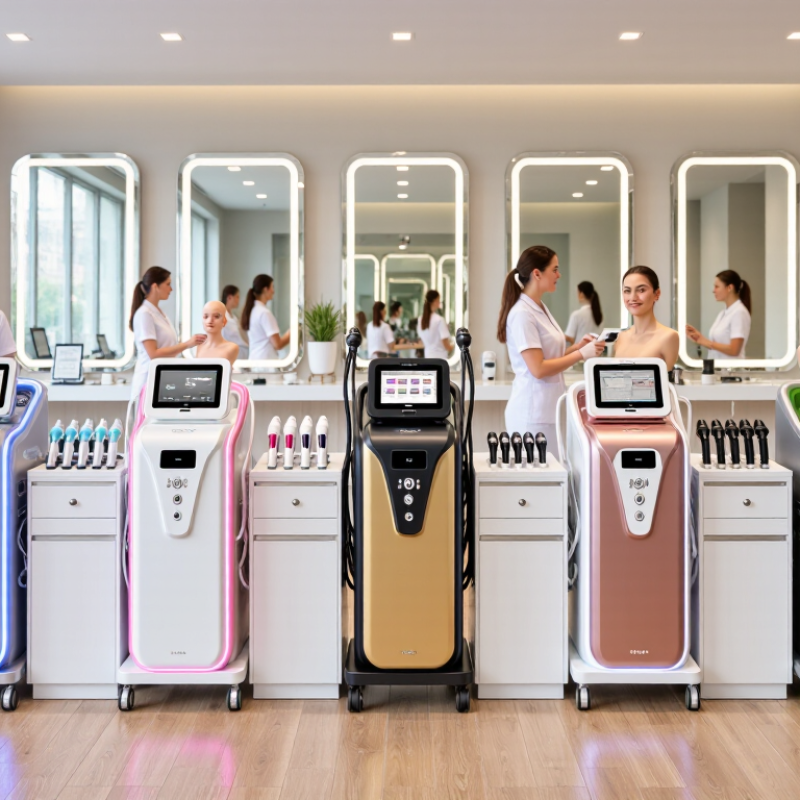
5 Best Multifunction Beauty Machines for Salons

Define Salon Multifunction Beauty Machines by Their Core Treatment Modalities

A salon multifunction beauty machine is best defined by the treatments it delivers, not by its number of attachments. Radiofrequency uses controlled heat to support skin-firming treatments, while ultrasound delivers energy below the skin’s surface. LED systems use specific light wavelengths for cosmetic skin-care protocols. Microcurrent devices provide low-level electrical stimulation, and hydrodermabrasion combines liquid exfoliation with suction. Different purposes.

These modalities are not interchangeable. A cool gel, clean handpiece, and recorded skin assessment matter during a real appointment. The American Society of Plastic Surgeons’ 2023 Procedural Statistics Report recorded 25.4 million minimally invasive cosmetic procedures in the United States. That figure covers a broad range of clinical procedures; it is not a count of salon-machine treatments. Still, it signals substantial interest in nonsurgical aesthetic care.

When comparing machines, match each modality to services staff can competently deliver. Check the operating instructions, treatment settings, cleaning requirements, and client-screening guidance. Not every salon needs every mode. A six-attachment device may be a poor fit if only two functions suit the salon’s clients, training, and room setup. Labels can blur, too: “lifting” or “rejuvenation” describes an intended cosmetic effect, not a guaranteed result.

Compare Five Platforms: Hydrodermabrasion, RF, IPL, Laser, and EMS

A salon comparing multifunction beauty machines should look beyond the number of handpieces. Hydrodermabrasion uses fluid flow and suction to cleanse and exfoliate the skin’s surface. It can suit a facial room where clients want a refreshed feel, though suction settings and skin sensitivity matter. Radiofrequency (RF) delivers controlled heat to deeper tissue. Its purpose and treatment feel differ from surface exfoliation, so staff need practical training and clear client screening. Not interchangeable.

IPL uses filtered, broad-spectrum light, while laser devices use a more focused wavelength. Both require careful attention to skin tone, hair or pigment targets, eye protection, and device-specific protocols. Their settings are not universally transferable. A salon should confirm that staff training, client assessment, and local operating requirements match the exact equipment. Small details matter, such as checking a client’s recent sun exposure before a light-based appointment.

EMS uses electrical impulses to stimulate muscle activity, creating a distinct sensation from light or heat treatments. It may fit a service menu focused on facial or body toning, but client comfort and suitability still need review. Ask suppliers for demonstrations, maintenance schedules, and realistic treatment parameters—not just dramatic before-and-after images. I would not choose a platform on feature count alone; honestly, a busy menu can become hard to manage without enough training time.

Compare Common IPL Cutoff Filters: 515, 560, and 590 nm

A salon’s multifunction IPL platform is only as versatile as its filter choices. A 515 nm cutoff admits more short-wavelength light, which can target superficial pigment and some redness.

It also increases melanin absorption, so skin tone, tanning, and cooling matter greatly. The 560 nm filter removes more of the shorter wavelengths and offers a practical middle ground for selected pigment or vascular concerns.

A 590 nm cutoff shifts treatment toward longer wavelengths, which generally reach deeper tissue and reduce—but do not eliminate—epidermal melanin competition. Small differences matter.

Babilas and colleagues’ 2010 review in Lasers in Surgery and Medicine describes IPL output as a broad spectrum, typically around 500–1200 nm. That range explains why a cutoff filter changes the delivered light; it does not guarantee a particular result.

In practice, pulse duration, fluence, contact cooling, and the client’s skin response also shape treatment. I would not treat filter numbers as a perfect treatment map.

A 515 nm setting may be unsuitable for some darker or recently tanned skin, while 590 nm is not automatically safer or more effective. Check the device’s technical guidance, document test spots and responses, and avoid promising results from wavelength alone.

Verify Electrical Safety Against the IEC 60601-1 Standard

A salon’s “best” multifunction beauty machine should be judged by more than its treatment menu. Check whether its electrical safety documentation matches the device’s intended use. IEC 60601-1 sets general requirements for basic safety and essential performance of medical electrical equipment. It addresses issues such as electric shock protection, insulation, and leakage current. Not every salon device automatically falls within its scope, so ask the manufacturer to clarify applicability and provide relevant test or certification records.

The risk is practical, not theoretical. NFPA’s report on home fires involving electrical distribution and lighting equipment estimated an annual average of 32,620 fires in the United States from 2015 to 2019. Those figures are not salon-specific, but they show why electrical checks matter. Before buying, inspect the plug, cable strain relief, housing, and emergency shutoff. Confirm that the unit’s voltage and circuit requirements suit the treatment room. A polished screen proves little. I would also verify that service staff can explain electrical inspection intervals; this detail is easy to overlook.

Tips: Request the IEC 60601-1 test report, not just a verbal claim. Check that the model number matches the document. Keep cables dry and unpinched, and remove damaged equipment from use. Small checks matter.

Rank Salon Options by Treatment Time, Uptime, and Three-Year Cost

For salons, the best multifunction machine is the one that keeps appointments moving without hiding long-term costs. Compare treatment time, expected uptime, service access, consumables, and training before ranking options. Actual results vary by model and operator.

Rank 1: An integrated facial platform can combine cleansing, exfoliation, and infusion in one visit. Its main advantage is a smoother room schedule, though setup and sanitation still take time.

Rank 2: A hydrodermabrasion system may suit repeat facial bookings, but count disposable tips and solution use in its three-year cost.

Rank 3: A LED and microcurrent combination offers flexible appointment planning. Check whether both functions can run reliably throughout a busy day.

Rank 4: A radiofrequency and ultrasound unit may cover varied service plans, but treatment times and staff training can reduce daily capacity.

Rank 5: A compact all-in-one device can save space and initial expense, yet one fault may disable several services. That matters. Estimate three-year cost using purchase price, maintenance, consumables, training, and lost appointment revenue during repairs. Ask for local service timelines and a hands-on workflow test. This ranking is imperfect: a slower unit with dependable support may outperform a faster machine that sits idle.

FAQS

How does hydrodermabrasion differ from RF?

Hydrodermabrasion uses fluid and suction to cleanse and exfoliate the skin’s surface. RF delivers controlled heat deeper in tissue. Different purposes. Staff training and sensitivity checks matter.

What should a salon consider before offering IPL or laser treatments?

Check skin tone, treatment target, eye protection, and device-specific instructions. Ask about recent sun exposure. Settings cannot simply be transferred between devices.

How do 515, 560, and 590 nm IPL filters differ?

The 515 nm filter admits more shorter-wavelength light. The 560 nm option sits between the others. The 590 nm filter shifts toward longer wavelengths, but does not guarantee safer or better results.

Does an IPL filter alone determine treatment results?

No. Pulse duration, energy level, cooling, and the client’s skin response also matter. Record test-spot responses. Wavelength numbers are not a perfect map.

What should staff review before using EMS?

EMS creates electrical impulses that stimulate muscle activity. Review client suitability and comfort, and explain the distinct sensation. Some details need a second look.

What should a salon verify about a machine’s electrical safety?

Request relevant safety test records and confirm they match the exact model. Inspect the plug, cable, housing, and emergency shutoff. A polished screen proves little.

How can a salon check whether a machine fits its treatment room?

Confirm voltage and circuit requirements before purchase. Keep cables dry and unpinched, and remove damaged equipment from use. Small checks matter.

What should a salon ask a supplier before buying?

Request a demonstration, maintenance schedule, realistic treatment parameters, and staff training details. Dramatic photos are not enough. Feature count can mislead.

Conclusion

Choosing a multifunction beauty machine begins with its core treatment modalities and the needs of the salon. This overview compares five platform types: hydrodermabrasion for water-based exfoliation and cleansing, radiofrequency (RF) for heat-based treatments, IPL for broad-spectrum light applications, laser platforms for focused light treatments, and EMS for muscle stimulation. It also explains how IPL cutoff filters at 515, 560, and 590 nm differ, so operators can assess whether a device’s configurations suit their planned services and client needs.

Before purchase, verify electrical safety documentation against the IEC 60601-1 standard and confirm that staff training, maintenance, and operating procedures are appropriate. The options are assessed by treatment time, expected uptime, and estimated three-year costs, helping salons compare more than the initial price. Together, these practical factors offer a framework for how to optimize salon services with multifunction beauty machines while balancing service range, workflow efficiency, equipment reliability, and ongoing expenses.

Isabella

Isabella

Isabella is a dedicated marketing professional with a sharp focus on driving brand growth and engagement through strategic content creation. With an extensive background in digital marketing, she combines her passion for storytelling with her keen understanding of industry trends to deliver......